VIII. POLICY IMPERATIVES
What Congress, Mayors, and Think Tanks Should Do Now
The Urgency
In March 2026, Senator Bernie Sanders sat down with Anthropic’s Claude AI for a 9-minute interview viewed by 4.4 million people. He pressed the machine on healthcare, inequality, and corporate power. The exchange revealed something important: the political class is waking up to automation, but the policy infrastructure does not exist yet. Sanders’ October 2025 report warned that “the same handful of oligarchs who have rigged our economy for decades” are deploying AI to concentrate power, not distribute benefit. He is right about the diagnosis. This chapter provides the prescription.
The window for proactive policy is narrow. As we demonstrated in Who Owns the Robots, ownership structures calcify in the first decade of an infrastructure build-out. Cloud computing consolidated to three firms in under 10 years. The robotic labor market will do the same unless policy intervenes before the fleet reaches critical mass. Every month of delay increases the political cost of intervention.
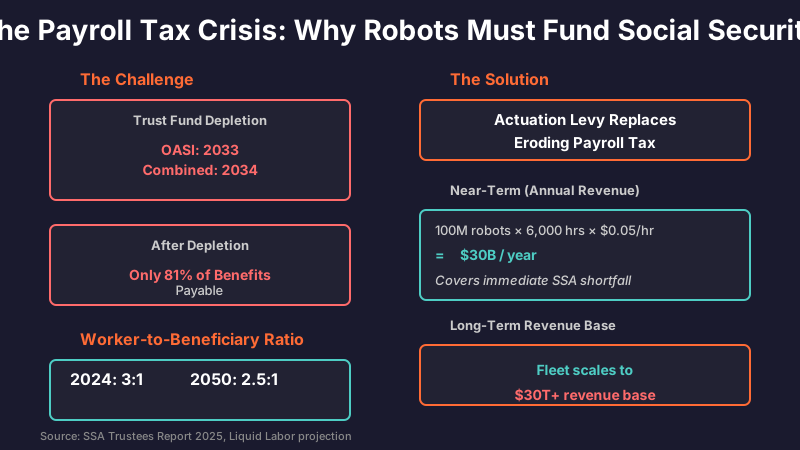
Source: SSA Trustees Report 2025, Liquid Labor projection. The Actuation Levy replaces eroding payroll tax revenue with robot-hour revenue.
I. Federal Legislative Actions
1. Establish the National Autonomous Work Index (NAWI)
What: Direct the Bureau of Labor Statistics to publish a quarterly National Autonomous Work Index alongside existing employment statistics. NAWI measures total effective robotic work-hours (N × h × φ) deployed across the economy.
Why: You cannot govern what you do not measure. GDP does not capture the labor substitution already underway. NAWI gives policymakers a leading indicator of displacement pressure, energy demand, and productivity gains from automation. Without it, Congress is flying blind.
Model legislation: Amend the BLS charter (29 U.S.C. § 1) to include autonomous labor measurement. Require firms deploying more than 50 robotic units to report hours and task categories quarterly, similar to EEO-1 employer reporting.
2. Create the National Robotics Council
What: Establish an independent federal body, modeled on the National Science Board or the Council of Economic Advisers, to advise on autonomous workforce policy, coordinate interagency action (DOL, DOE, DOD, Commerce), and publish an annual State of the Autonomous Workforce report.
Why: Automation policy currently has no institutional home. DOL handles human workers. DOE handles energy. DOD handles defense tech. No agency is tasked with the intersection: robotic labor capacity, energy constraints on fleet growth, and workforce transition. The National Robotics Council fills that gap.
3. Pass the Actuation Levy Act
What: Levy a micropayment per autonomous robot-hour worked, analogous to payroll tax on human wages. Start at $0.05/hour and index to NAWI growth. Revenue funds the Basic Dividend and workforce transition programs.
Why: As robots replace human workers, the payroll tax base (which funds Social Security and Medicare) erodes. The Actuation Levy replaces lost payroll revenue with robot-hour revenue. It scales automatically: more robots = more revenue. At 100 million robots working 6,000 hours/year at $0.05, the near-term yield is $30 billion annually. As the fleet scales to 1 billion+ units over 20–30 years, the revenue base approaches $30 trillion, comparable to the total U.S. labor compensation pool it replaces. See Scale-Effect Trap for the full derivation.
4. Authorize the National Autonomous Workforce Corporation (NAWC)
What: Charter a government-sponsored enterprise (GSE), structured like Temasek (Singapore) or the Government Pension Fund (Norway), to own and operate the sovereign robot fleet. NAWC purchases, deploys, and leases robot-hours to private firms via RaaS contracts. Surplus revenue flows to the Basic Dividend.
Why: If the federal government does not establish public ownership of the foundational fleet, the Depreciation Bomb guarantees that 5 private corporations will own 90% of robotic labor capacity within a decade. NAWC secures the productive base as public infrastructure, the way the interstate highway system secured transportation and the TVA secured rural electrification.
5. Robot Investment Tax Credit (RITC)
What: A 30% investment tax credit for domestic purchase or lease of autonomous systems, modeled on the solar ITC (Section 48 of the Internal Revenue Code). Sunset after 10 years or when NAWI reaches a target threshold.
Why: Accelerates adoption by reducing effective cost, steepening the U.S. learning curve against China’s cost advantage. The solar ITC drove costs down 90% over two decades; a robot ITC can do the same for autonomous systems.
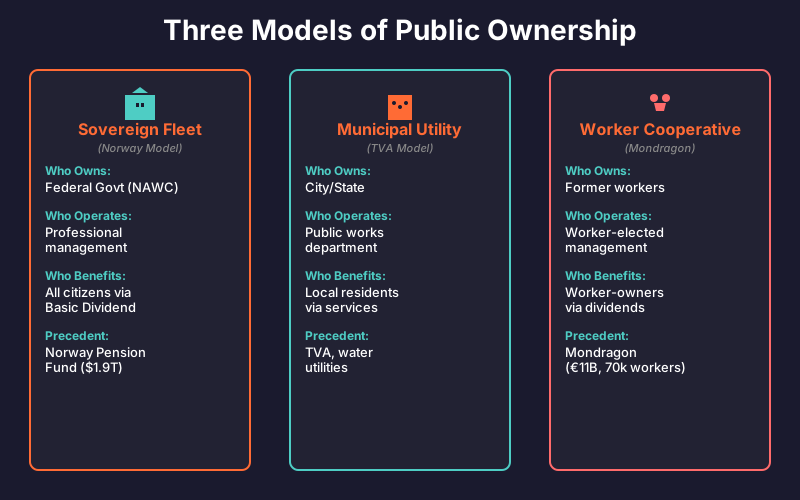
Source: Norges Bank, Temasek Review, MONDRAGON Corporation. Three proven governance models applied to robotic fleet ownership.
II. Municipal & State Actions
6. Municipal Robot Utilities (MRUs)
What: Cities create public robot utilities for infrastructure maintenance, sanitation, elder care, and building inspection. Funded like existing public works departments; operated by civil servants, not shareholders.
Pilot target: New York City, with 8.3 million residents, 6,300 miles of streets, and an aging infrastructure deficit estimated at $47 billion (NYC Comptroller, 2024). An MRU deploying 5,000 robots for road repair and sanitation could save $800M–$1.2B annually in labor and overtime costs while delivering 24/7 service. The Mayor’s office should commission a feasibility study within 12 months. For housing: Mayor Mamdani has pledged 200,000 new affordable units. Robotic construction fleets, operating 24/7, immune to weather delays, could cut construction timelines by 40–60% and reduce per-unit costs by 20–30% (McKinsey Global Institute, 2023). MRUs are how New York actually builds those homes. Union construction workers transition to fleet operators and maintenance roles at equivalent or higher wages, supervising 50 robots instead of swinging 50 hammers.
7. Robot Parks & Energy Corridors
What: States designate “Robot Parks”, pre-zoned, pre-permitted industrial zones with guaranteed grid capacity (5–15 GW), co-located power generation, and fast-track construction permits for robotics factories.
Why: The U.S. faces 4–7 year permitting delays for new energy generation (DOE, 2024). China builds 50 GW of new capacity per year. Robot Parks collapse the permitting timeline and guarantee the energy infrastructure that fleet scaling requires. Without dedicated corridors, AWN growth will hit the energy ceiling described in the main thesis.
8. Worker Cooperative Conversion Programs
What: State legislatures pass “Right to Convert” laws giving workers at firms implementing mass automation a first-refusal option to form Robot Cooperatives. Modeled on existing employee stock ownership plan (ESOP) tax incentives. Workers convert wage income to dividend income as robots replace their tasks, preserving ownership distribution.
Precedent: Mondragon Corporation (Spain) operates 95+ cooperatives with over 70,000 worker-owners and €11B in annual revenue, proving the model scales to industrial complexity. Colorado’s Employee Ownership Act (2019) and Maine’s Employee Ownership Center already provide legislative templates.
III. Addressing the Nanny State Concern
The first question every fiscal conservative asks is: “How do we pay for it?” And behind that lies a real concern: public ownership = unsustainable entitlements. If the state owns the robot fleet and distributes its surplus as a Basic Dividend, isn’t that just another broken welfare program destined to bankrupt the treasury?
No. The Liquid Labor framework is not a new entitlement. It is a revenue reallocation in response to structural change. Here are the numbers:
1. The Social Security Crisis Is Already Real. The Social Security Trust Fund will be depleted in 2034 (SSA Trustees Report, 2025). After depletion, only 81% of scheduled benefits are payable without additional revenue. The worker-to-beneficiary ratio was 3:1 in 2024 and is projected to fall to 2.5:1 by 2050. Every robot that replaces a worker is one fewer payroll taxpayer funding the system. Automation accelerates the demographic cliff. If Congress does nothing, beneficiaries automatically get a 19% benefit cut in 2034. That is the real nanny state failure.
2. The Actuation Levy Is Not New Spending, It’s Revenue Replacement. Social Security currently taxes 12.4% of wages: 6.2% from employers, 6.2% from employees (as of 2025). As robots replace workers, this payroll tax base erodes. The Actuation Levy does not increase total taxation on productive capacity. It shifts the tax from human-hours to robot-hours. It recaptures the revenue that disappears when automation eliminates wages. At 100 million robots working 6,000 hours per year at a $0.05/hour levy, the near-term yield is $30 billion annually. As the fleet scales to 1 billion+ units over 20-30 years, the revenue base approaches $30 trillion, comparable to the total U.S. labor compensation pool the Levy replaces. It is structurally sustainable because it taxes the resource (robotic work) that replaces the taxed resource (human work).
3. NAWC Is Not a Cost Center, It’s a Profit Center. Norway’s Government Pension Fund returned 15.1% in 2025 on $1.9 trillion in assets (Norges Bank, 2025). Singapore’s Temasek returned commercial rates on S$484 billion (Temasek Review, 2025). NAWC operates under the same principle: it leases robot-hours at market rates to private companies via RaaS contracts. The revenue exceeds operating costs because robot labor is cheaper than human labor, that is literally the point of automation. The surplus funds the Basic Dividend. NAWC does not require deficit spending. It is a revenue generator masquerading as an expense.
4. Municipal Robot Utilities Reduce Costs, Not Increase Them. New York City alone spends $2.4 billion per year on sanitation (NYC Mayor’s Management Report). A Municipal Robot Utility deploying robots for sanitation could cut costs 30-50% while providing 24/7 service. This is a spending reduction, not an increase. Across the U.S., similar opportunities exist in road repair, building inspection, park maintenance, and elder care. MRUs pay for themselves through efficiency gains and eliminated overtime costs.
5. The Do-Nothing Cost Is Higher. If Congress does not establish public ownership and the Actuation Levy, the payroll tax base will collapse without replacement revenue. Social Security benefits will be cut 19% automatically in 2034. Medicare will follow. Unemployment will spike as robots displace workers without offsetting demand. The deficit will explode as tax revenue vanishes. The real fiscal catastrophe is inaction.
Frame it this way: The Actuation Levy is the fiscally conservative position. It replaces eroding revenue with new revenue, keeps Social Security and Medicare solvent, prevents a public sector budget crisis, and funds the Basic Dividend without permanent deficits. Doing nothing is the radical position, it guarantees a 19% benefit cut, unemployment spikes, and fiscal collapse.
IV. Think Tank Research Agenda
The following research questions are designed for policy institutes, university labs, and government advisory bodies. Each connects directly to a legislative action above:
1. NAWI Measurement Methodology. How should BLS define and collect autonomous labor data? What reporting thresholds and task taxonomies are appropriate? The IFR’s World Robotics Report covers industrial robots but excludes software agents, autonomous vehicles, and drones. A comprehensive NAWI methodology must encompass all forms of productive automation.
2. Optimal Actuation Levy Rate. What per-hour rate balances revenue generation with adoption incentives? Model the Laffer curve for robot-hours: too high a levy chokes adoption; too low fails to replace payroll tax revenue. ARK Invest and Goldman Sachs robotics cost models provide the demand-side inputs.
3. Displacement Elasticity Estimation. Empirically measure σ (the economy’s ability to reallocate displaced workers) across sectors. This determines how fast automation can scale before transition support is overwhelmed. Current estimates from Acemoglu & Restrepo (2020) and Autor (2022) provide baselines but predate the humanoid robot era.
4. Energy Ceiling Modeling. Map the intersection of AWN growth trajectories and regional grid capacity. Identify which U.S. regions will hit energy ceilings first under base-case and aggressive scenarios. DOE and LBNL grid interconnection data provide the supply-side inputs.
5. NAWC Governance Design. How should the sovereign fleet corporation be governed to avoid capture by either political interests or private lobbying? Comparative analysis of Norway’s Government Pension Fund ($1.9T), Singapore’s Temasek (S$484B), and Alaska’s Permanent Fund ($78B) provides three distinct governance models with track records.
6. Cooperative Conversion Economics. Under what conditions does worker-to-owner conversion preserve income parity? Model the transition path from wage income to dividend income as a function of fleet size, utilization, and RaaS pricing.
V. Novel Mechanisms: What Has Not Been Tried
Robot taxes failed. UBI didn’t move the needle on employment. State-directed investment bred corruption. The standard policy menu is exhausted. The following three mechanisms have never been implemented at scale but have strong precedent from adjacent domains. They fill specific gaps in the Liquid Labor architecture.
9. Automation Displacement Insurance Pools
What: Mandatory, sector-specific insurance pools funded by automation adopters. When a firm deploys labor-replacing technology, it pays into a sectoral pool, the way employers pay into workers’ compensation today. When workers are displaced, the pool pays out: 18–36 months of income replacement, retraining grants, relocation assistance. Insurers compete to price displacement risk accurately and have financial incentive to prevent displacement or fund smooth transitions.
Why it works: Sweden’s job security councils (trygghetsrad) achieve 90% reemployment within 6–24 months using employer-funded transition support at 0.3% of wages. Social impact bonds have deployed $745M globally with outcome-based financing. This mechanism combines both: private capital absorbs displacement risk, and the market prices it efficiently. Unlike UBI, it pre-funds the transition before the worker loses income. Unlike the Actuation Levy, it is self-actuating, the insurance pool triggers automatically when displacement occurs.
Gap it fills: The Liquid Labor framework assumes asset distribution (Basic Dividend) solves the income gap. But there is a temporal problem: workers lose jobs now while the dividend takes years to scale. Displacement insurance bridges that gap.
10. Dynamic Energy-Based Automation Tax
What: Tax automation proportional to its measurable energy consumption rather than robot headcount. Rates adjust dynamically: when regional labor displacement exceeds absorption capacity, the rate rises. When labor markets tighten, it falls. This creates an automatic stabilizer, a congestion price for automation.
Why it works: The EU robot tax failed because nobody could define “robot.” Energy consumption is measurable at scale, utilities already track it. Dynamic adjustment mirrors congestion pricing proven in London, Singapore, and Stockholm. The rate is objective (Joules consumed), evasion-resistant (energy footprints cannot be offshored without offshoring the work), and self-stabilizing (rapid automation in slack markets faces higher cost, slowing displacement to absorb capacity). This is the Entropy Tax from Chapter III made operational.
Gap it fills: The Actuation Levy is static, $0.05/hour regardless of market conditions. A dynamic energy tax adds adaptive intelligence and is harder to game through definitional arbitrage (“this isn’t a robot, it’s a CNC machine”).
11. Data-as-Labor Cooperatives
What: Sector-specific cooperatives where workers collectively own and monetize the behavioral and productivity data generated during their work. Firms training AI systems on worker data must license it from the cooperative. 60–70% of licensing revenue returns to worker-members proportional to their data contribution. Democratic governance through member voting prevents race-to-the-bottom individual data sales.
Why it works: Workers generate the training data that builds the AI systems that replace them, a form of unpaid labor. ASCAP (music licensing) and pharmaceutical royalty pools already operate collective licensing at scale. Stanford HAI and the EU Digital Services Act have both flagged data cooperatives as viable models. Colorado’s data cooperative legislation provides an early template.
Gap it fills: Liquid Labor focuses on physical robot capital. But the faster-growing displacement threat is software automation and AI agents trained on worker-generated data. Data cooperatives capture value from this parallel automation vector that the Actuation Levy and NAWC do not address.
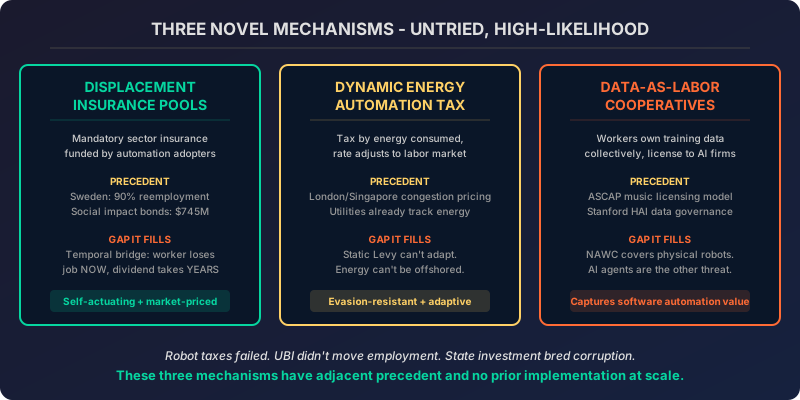
Source: Swedish Job Security Councils (TUAC/OECD, 2022), London Congestion Pricing (TfL), Stanford HAI Data Cooperatives research.
VI. The Sanders Test
Senator Sanders asked the right question: does AI benefit workers or just corporate CEOs? The Liquid Labor framework provides a structural answer, not a rhetorical one. The policies above ensure that:
Workers are not left behind. The Actuation Levy replaces eroding payroll tax revenue. The Basic Dividend distributes the surplus of robotic labor to every citizen. Cooperative conversion preserves worker ownership through the transition. Sanders’ proposed 32-hour workweek finds its structural mechanism here: as NAWI grows, the Time Dividend redistributes productivity gains as reduced hours rather than unemployment. Robots work the hours humans shed. These are not welfare programs, they are structural mechanisms that ensure the gains from automation flow to the public.
Concentration is prevented, not reversed. NAWC and MRUs establish public ownership before private monopolies form. This is cheaper, legally simpler, and more effective than trying to break up automation monopolies after the fact. AOC’s data center moratorium is a holding action, necessary, but temporary. The Liquid Labor framework provides the structural alternative: publicly owned robotic infrastructure with union jobs in fleet operation, maintenance, and oversight. The lesson of cloud computing: you don’t regulate Amazon Web Services back to competitive market structure. You build the public alternative before the market locks in.
The market still works. Private RaaS operators and cooperatives compete in Tier 3. Innovation is not stifled. But the foundational productive capacity, the national Time Bank, is publicly held, the way highways, the grid, and the GPS constellation are publicly held. This is not socialism. It is infrastructure.

Source: Liquid Labor framework. Revenue from robot-hours funds three streams: citizen dividends, workforce transition, and fleet reinvestment.
VII. Immediate Next Steps
For Members of Congress: Introduce a study resolution directing CBO to score the Actuation Levy and NAWC proposals. Request GAO analysis of the payroll tax erosion trajectory under current automation trends. These are low-cost, non-partisan first steps that generate the data needed for legislation.
For the Mayor of New York City: Commission a Municipal Robot Utility feasibility study through the Mayor’s Office of Operations or the NYC Economic Development Corporation. Scope: sanitation, road repair, building inspection, and affordable housing construction. Estimated study cost: $2–5M. Potential annual savings: $800M–$1.2B on infrastructure alone, plus a credible path to delivering 200,000 affordable housing units at 20–30% lower per-unit cost via robotic construction fleets. The return on the study alone is astronomical.
For Think Tanks (Brookings, AEI, New America, Manhattan Institute, Niskanen Center): Convene a bipartisan working group on Autonomous Workforce Governance. Publish the first NAWI estimate using available IFR, Census, and BLS data. Model the Actuation Levy revenue curve under conservative, base, and aggressive fleet scenarios. The Liquid Labor framework provides the analytical structure; the think tank provides the institutional credibility and political bridge.
For State Legislatures: Pass enabling legislation for Municipal Robot Utilities and Cooperative Conversion programs. Colorado, California, and New York are natural first movers given existing ESOP infrastructure and tech-sector concentration.
VIII. What the World Has Tried
Liquid Labor is not the first attempt to govern automation. Others have tried. Most have failed. The design of this framework is informed by what went wrong elsewhere, and the few things that worked.
The Failures
Robot taxes don’t work. The European Parliament voted down a robot tax in February 2017 (396–123). Bill Gates proposed one the same year; economists called it “profoundly misguided.” South Korea tried a softer version, reducing tax deductions for automation investments, and saw modest effects: a small decline in robot installations and reduced wage inequality, but nothing structural (Restriction of Special Taxation Act, Article 24, 2017). The problem is definitional: what counts as a “robot”? A software agent? A self-checkout lane? A CNC mill? Taxing the category penalizes adoption without capturing the value.
UBI alone doesn’t solve displacement. Switzerland held a national referendum on universal basic income in June 2016. It lost 76.9% to 23.1%, every canton voted no. Finland ran a two-year experiment (2017–2018) giving 560 unemployed citizens €560/month. Employment increased by exactly 6 days over 2 years. Wellbeing improved significantly, less depression, more optimism, but the structural problem remained untouched. Across 122+ global UBI pilots, average employment gains are 0.8 percentage points (University of Helsinki, 2020; The Daily Economy, 2024). Cash transfers treat the symptom. Ownership treats the cause.
State-directed automation investment breeds corruption. China’s National Integrated Circuit Industry Investment Fund (“Big Fund”) deployed $30 billion to build a domestic semiconductor industry. Six major projects failed. Four top executives were arrested on corruption charges. Tsinghua Unigroup, a Big Fund recipient, filed for bankruptcy in 2021. In robotics, manufacturers installed cheap robots to qualify for subsidies, then left them unused. Despite billions in state funding, 85% of China’s robotics sales still came from imported products (Engineering.com, 2022). The lesson: state money without governance transparency produces waste, not capacity.
Doing nothing is worst of all. The UK fell to 98 robots per 10,000 manufacturing workers after Brexit, below the global average of 151, and dropped out of the top 10 manufacturing nations entirely. Decades of cheap migrant labor removed the incentive to automate. When labor vanished overnight, 20,000 of 27,000 SMEs had zero robots. The result: 95,000 unfilled manufacturing vacancies and productivity potential 22.3% below what automation could deliver (IFR, 2024; The Manufacturer, 2025). Path dependency is real. If you don’t build the fleet, you don’t get the capacity.
What Actually Works
Sovereign ownership works. Norway’s Government Pension Fund ($1.9T, 15.1% return in 2025) and Singapore’s Temasek (S$484B) prove that publicly-owned, commercially-operated entities generate returns that rival or exceed private markets. The mechanism: professional management, competitive hiring, market-rate leasing, but profits flow to citizens, not shareholders. NAWC is designed on this template.
Institutional retraining works. Sweden’s job security councils (trygghetsrad), funded by employers at 0.3% of total wages via collective bargaining, achieve 90% reemployment within 6–24 months. Two-thirds of workers land jobs at higher salaries. Danish flexicurity spends more on active labor market programs than any OECD nation: hire and fire easily, retrain comprehensively. Swedish unions do not fight automation because the safety net is real. This is the model for Cooperative Conversion Programs.
Japan shows the limits of robotics without ownership policy. Japan invested heavily in care robotics to address a projected 570,000 care worker shortage by 2040. Results are mixed: productivity gains exist, but humanoid units cost $67,000 each, malfunctions increase staff workload, and adoption is slow. Technology without institutional design does not solve structural problems. You need both the fleet and the governance.
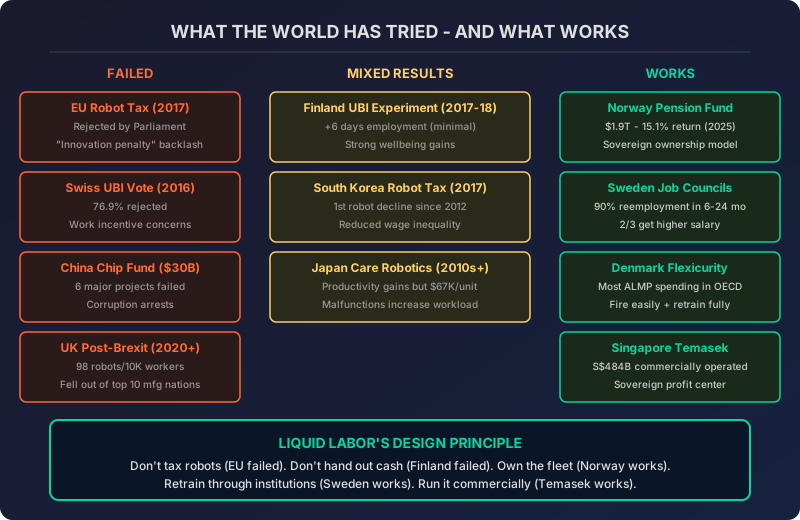
Source: EU Parliament (2017), IFR (2024), University of Helsinki (2020), Norges Bank (2025), Swedish Job Security Councils, Temasek Review (2025).
IX. What Could Go Wrong
A framework that cannot name its own failure modes is not a framework. It is a sales pitch. Here are the five ways Liquid Labor could fail, and the design features intended to prevent each.
1. NAWC becomes a patronage machine. China’s Big Fund proves that state-directed technology investment attracts corruption like gravity attracts mass. If NAWC board appointments are partisan, if contracts go to connected firms, if regional fleet allocation follows electoral maps instead of economic need, it becomes the next Fannie Mae, not the next Norway Fund. Design response: NAWC governance must mirror Norway’s model: independent board appointed by bipartisan commission, transparent competitive bidding, external audits, and statutory whistleblower protections. Political appointees run the oversight committee. Professionals run the fund.
2. The Actuation Levy drives offshoring. If the U.S. levies $0.05/hour on robot labor and Mexico or Vietnam levy nothing, rational firms move the robots. This is the same arbitrage that emptied the Rust Belt. Design response: The Levy must be paired with border adjustments, a Robot Carbon Border Adjustment Mechanism (RCBAM) that tariffs imports from jurisdictions without equivalent levies. The EU’s Carbon Border Adjustment Mechanism (CBAM, effective 2026) provides the legal template. Additionally, the Robot Investment Tax Credit (RITC) offsets the Levy cost for domestic deployment: net effect is neutral for firms that build here, punitive for firms that offshore.
3. MRUs displace workers faster than retraining catches up. Brookings warns that AI displacement could compress what took decades of computerization into 5–10 years. The U.S. spends 0.1% of GDP on active labor market programs vs. 0.6% OECD average. Sweden’s system works because it was built before the crisis. Design response: MRU deployment must be phased to retraining capacity: no city expands fleet beyond what its Cooperative Conversion pipeline can absorb. The Actuation Levy dedicates 30% to transition programs by statute, not by appropriation, which Congress can cut. Mandatory, not discretionary.
4. Norway-style ethical dilemmas paralyze the fund. Norway’s fund faces mounting political pressure: defense industry divestment debates, ESG screening conflicts, and a year-long ethics review pause ordered by Parliament in 2025. If NAWC owns the national robot fleet and political factions weaponize divestment demands, the fund cannot operate. Design response: NAWC’s mandate is narrow and operational: own and lease robot-hours for productive work. It is not a general-purpose investment fund. There is no portfolio to divest from, the assets are robots, not equities. The ethical question is simple: does the fleet produce useful work? If yes, it operates. The narrow mandate is the firewall against mission creep.
5. The public just doesn’t care until it’s too late. Switzerland voted 76.9% against UBI. EU citizens rejected the robot tax through their Parliament. Americans have not elected a single candidate on an automation platform. The Overton Window may not move fast enough. Design response: You don’t wait for the window. You move it. The Social Security Trust Fund depletes in 2034. That is 8 years. When the first benefit checks get cut 19%, every American over 50 will care about the Actuation Levy. The framework must be ready before the crisis creates demand for it. That is the purpose of this chapter.
X. The Machine Manifesto
Marx identified the central contradiction of industrial capitalism: those who own the means of production extract the surplus from those who operate them. He was right about the diagnosis. He was wrong about the prescription. Seizing the factories required revolution. Seizing the robots requires legislation.
The machine economy inverts the labor question entirely. For the first time in history, the means of production do not require a proletariat. Robots do not strike. They do not demand wages. They do not form unions. They do not vote. This is either the most dangerous development in economic history, a permanent rentier class with no structural need for workers at all, or it is the final liberation: a world where the surplus of productive labor belongs to everyone because the labor itself is performed by machines owned by everyone.
The difference between those two futures is not technology. It is ownership. It is policy. It is the decision we make in the next ten years about who holds title to the autonomous workforce.
Every industrial revolution has produced a manifesto. The first gave us The Wealth of Nations. The second gave us Das Kapital. The third gave us Keynes. The fourth, the one we are in now, has produced nothing. No framework. No theory. No institutional architecture for a world where machines do the work and humans collect the dividend.
This is that framework. Liquid Labor is the political economy of the machine age. NAWI is its metric. The Actuation Levy is its fiscal mechanism. NAWC is its institution. The Basic Dividend is its promise. And the Time Bank is its reserve, a store of productive capacity more real than gold, more durable than currency, more democratic than equity.
The workers of the world have nothing to lose but their obsolescence. They have a Time Bank to win.
The autonomous workforce is coming whether policy is ready or not. The only question is who it serves. These imperatives ensure it serves the public.
Sources
- [1] eWeek, “Bernie Sanders Interviewed an AI Chatbot on Camera, 4.4M People Watched,” March 2026.
- [2] Sen. Bernie Sanders, “Report on the Dangers of Artificial Intelligence,” October 2025. Warned that AI concentrates power unless Congress ensures workers benefit.
- [3] Synergy Research Group, “Cloud Market Share Trends, Big Three Hold 63%,” Q3 2025. Demonstrates infrastructure market consolidation pattern.
- [4] Norges Bank Investment Management, Government Pension Fund Global, 2025. $1.9T sovereign fund model for NAWC design.
- [5] Temasek Review 2025. S$484B commercially-operated sovereign entity model.
- [6] MONDRAGON Corporation, 2024. 95+ cooperatives, 70,500 workers, €11B revenue. Cooperative ownership model at industrial scale.
- [7] International Federation of Robotics, “World Robotics Report,” 2024. Global robot deployment data for NAWI baseline estimation.
- [8] Acemoglu, D. & Restrepo, P., “Robots and Jobs: Evidence from US Labor Markets,” JPE 2020. Empirical baseline for displacement elasticity (σ).
- [9] Autor, D., “The Labor Market Impacts of Technological Change,” NBER 2022. Framework for understanding automation’s effects on employment composition.
- [10] NYC Comptroller, Infrastructure Investment Assessment, 2024. $47B infrastructure deficit estimate for NYC.
- [11] International Energy Agency, World Energy Outlook 2024. China energy infrastructure build-out data for energy ceiling modeling.
- [12] U.S. DOE Grid Deployment Office, 2024. Grid interconnection delays and permitting data.
- [13] European Parliament, “Civil Law Rules on Robotics,” February 2017. Robot tax proposal rejected; civil liability framework adopted.
- [14] University of Helsinki, “Finland Basic Income Experiment Results,” 2020. +6 days employment, strong wellbeing gains, structural unemployment unchanged.
- [15] Library of Congress, “Switzerland: Voters Reject Unconditional Basic Income,” June 2016. 76.9% rejection in national referendum.
- [16] TUAC/OECD, “Swedish Job Security Councils,” 2022. 90% reemployment within 6–24 months; employer-funded at 0.3% of wages.
- [17] Denmark.dk, “The Danish Labour Market Model (Flexicurity).” Most active labor market program spending in OECD.
- [18] Engineering.com, “Subsidy Fraud in China’s Robotics Industry,” 2022. 85% import dependence; unused robots installed for subsidies.
- [19] IFR, “Brexit: UK Falling Back in Global Automation Race,” 2024. 98 robots/10K workers; 20,000 SMEs with zero robots.
- [20] Social Finance, “Pay for Success / Social Impact Bonds.” $745M deployed globally via outcome-based financing.
- [21] Stanford HAI, “Data Cooperatives Could Give Us More Power Over Our Data,” 2021. Democratic data governance model.
- [22] London/Singapore/Stockholm Congestion Pricing. Dynamic rate adjustment proven at urban infrastructure scale.
- [23] McKinsey Global Institute, “Reinventing Construction,” 2023. Robotic construction cuts timelines 40–60%, costs 20–30%.
- [24] Cerron, U.J. (2025–2026). Liquid Labor framework. NAWI definition, Actuation Levy, NAWC architecture, Basic Dividend, Three-Tier ownership model.